Boundaries: Necessary, Not an Accessory

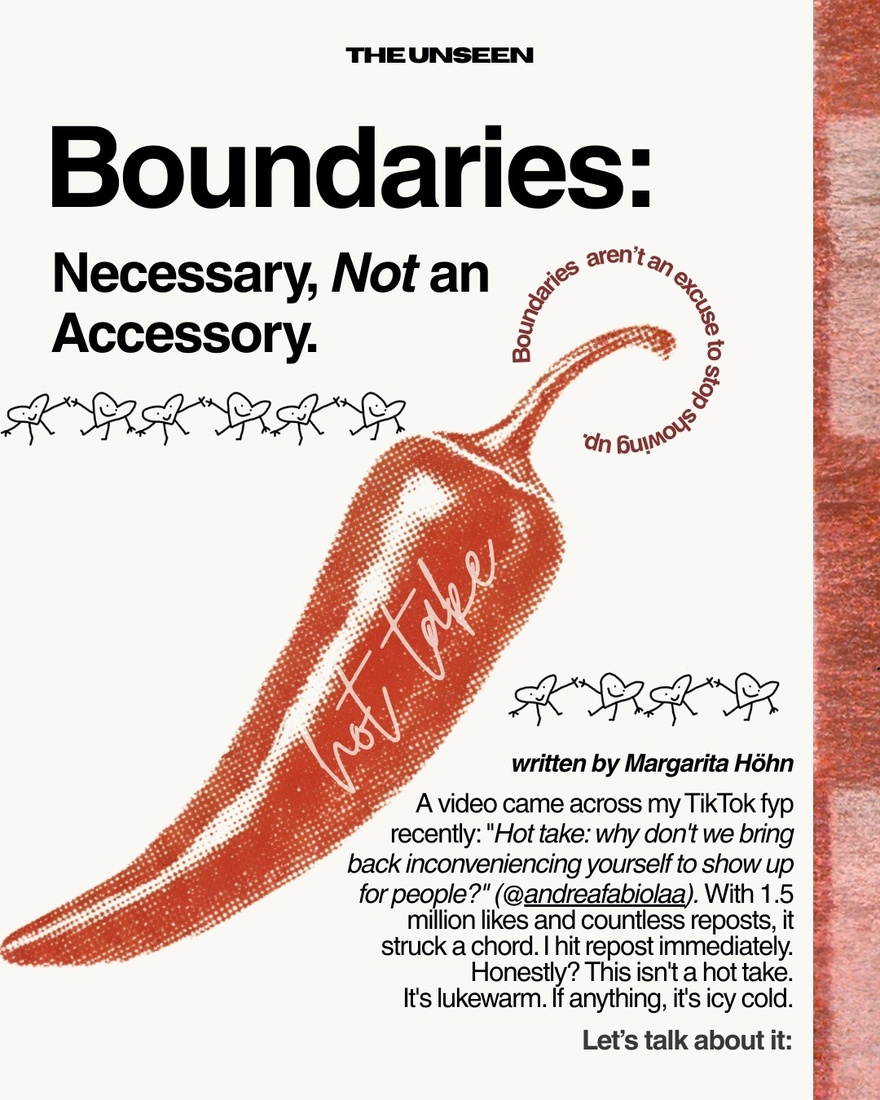
A video came across my TikTok fyp recently: "Hot take: why don't we bring back inconveniencing yourself to show up for people?" (@andreafabiolaa). With 1.5 million likes and countless reposts, it struck a chord. I hit repost immediately. Honestly? This isn't a hot take. It's lukewarm. If anything, it's icy cold. Let’s talk about it:
First, let me be abundantly clear: boundaries are essential. They're vital. They're the invisible line we draw to define what behaviour we will, and won't accept, to protect our wellbeing and sense of self. Establishing them is necessary. Respecting them is sacred. Every person deserves to be treated with dignity regarding their own being.
But somewhere between therapytok, Instagram infographics, the self-diagnoses, and amateur psychology, we have forgotten what boundaries actually are. We have transformed them into something far more fashionable and far less functional: an accessory. A shield. An ace up someone's sleeve. A get-out-of-jail-free card lying on your bedside table, ready to be used, that somehow makes it socially acceptable to stop showing up and socially unacceptable to question it. We need a reminder that a boundary isn't an excuse. A boundary isn't an endless justification for opting out. A boundary is a necessity for your well-being – not a cute handbag you carry around to feel better about yourself.
I have been thinking a lot about how we got here, and I think I have an answer: awareness of mental health has risen, which is great. Gen Z normalised conversations about depression, anxiety, and trauma, whether it is online or in real life – which is genuinely needed. The stigma around therapy softened, and people started talking about their struggles without shame. These are victories for our generation. Yet, there are always two sides to a coin: While talking about mental health online really helped raise awareness to such an important topic, with it came TikTok psychology. Suddenly, everyone is a therapist. Everyone diagnoses themselves and others as if they are handing out free samples of ice cream at a shop. Terms like "protecting my peace", "honouring my inner child", and "toxic patterns" become synonyms for "I don't want to deal with this." Has anyone ever actually verified that these people giving mental health advice are real therapists, as they claim? Probably not. But that didn't stop anyone from liking, sharing, or adapting. Additionally, to this problem, the pandemic happened. The world went quiet and stopped. Lockdown and social distancing forcefully retreated everyone into their homes, and apparently, something was discovered in isolation: comfort. We got so comfortable with being comfortable that we forgot how to do anything else. A wave of intolerance for chaos, for unpredictability, and being around other people overcame the entire population, it seems. Something probably not helping was the "main character" trend – yes, technically, you are the main character of your own life, but life isn't a Netflix series. You can't treat people around you like supporting characters and expect them to remain in your story. Exposing people to therapy vocabulary became a weapon for them to become a more self-indulgent version of themselves. Overall, now there is a generation fluent in a language of boundaries but uneducated in what these concepts actually carry in meaning, consequently acting selfishly under the disguise of self-care.
Setting boundaries has become a convenient excuse everyone is using now, and it has to stop. You don't want to go to your friend's birthday because themed birthday parties aren't your thing? Fine, it doesn't have to be your thing. But your friend asked you to be there. Show up for an hour. Celebrate with them. That's not disrespecting your boundaries – it's being a good friend. Friendships are there to celebrate your friends' achievements and milestones. You promised to help a friend move and then changed your mind? You made a prior commitment. You stick to it. "Keeping your boundary" because you don't feel like it is still flaking on them, just with better PR – and the thing about PR is that most people can see through the strategies. Your friend's farewell party is tomorrow, and you're still hungover from the night before? Yeah, that sucks. You go anyway. For them, not for you. That is what showing up for someone means. You’re tired? Everyone is. Your nervous system overwhelmed? Welcome to living through 2025. Most people don't feel like doing things on any given occasion – that is not being triggered by something or a boundary issue, it is just humane. It's called living, and it requires occasionally doing things even if you'd rather stay in bed and rewatch The Summer I Turned Pretty.
How come everyone wants a village – the beautiful idea of a support system or chosen family – but apparently, no one wants to be a villager. No one wants to show up or inconvenience themselves to take care of people. Instead, we all live in a constructed ghost town full of people isolating themselves and protecting their peace. The worst part: we made it socially impossible to call it out. If you're upset that someone keeps canceling on you, if you want your friends to show up for you the way you show up for them, you become the villain. You're the one with unhealthy expectations. You're the one who doesn't understand modern relationships. But here's the actual thing: people can go on with their "I don’t owe them anything, I am my own person and main character" mentality, but people don't owe you a friendship either. I've ended friendships over this. I'm not ashamed to admit it. I'd rather be ghosted than have a friendship with someone hiding behind a veil of "boundaries" and adjusting to being there for someone the way they need it.
I think it is super important to know what real boundaries look like: Boundaries protect you. They're necessary. They keep your identity safe from people who don't deserve your energy. However, they shouldn't be used as an excuse to never inconvenience yourself again. Relationships are built on a foundation of several things – communicated boundaries, showing up for each other, sitting through conversations they'd rather avoid, and those who show up to your birthday even if they're exhausted.
Protect your peace. Build your boundaries. But you need to understand: every time you bail because "you don't feel like it," and you pull out the boundaries card when someone needs you, you‘re slowly dismantling the relationship. At first, it's fine. But eventually they start to fade, and you're alone in a village you built that turned into a ghost town.
In a world full of conflict and uncertainty, we need each other more than ever. We need to remember how to reconnect with people again. To sit with discomfort. The people worth keeping in your life are the ones who inconvenience themselves for you. In turn, you have to do the same. That is how friendships work. Generally not a hot take. It should be the bare minimum. However, it is apparently necessary to say this nowadays.
WRITTEN BY

Meggi
Everything around pop & fan culture has been an integral part of my life for over 10 years and I have the urge to tell everyone about it.