In Conversation with Harun Tekin: A Dictionary of Night

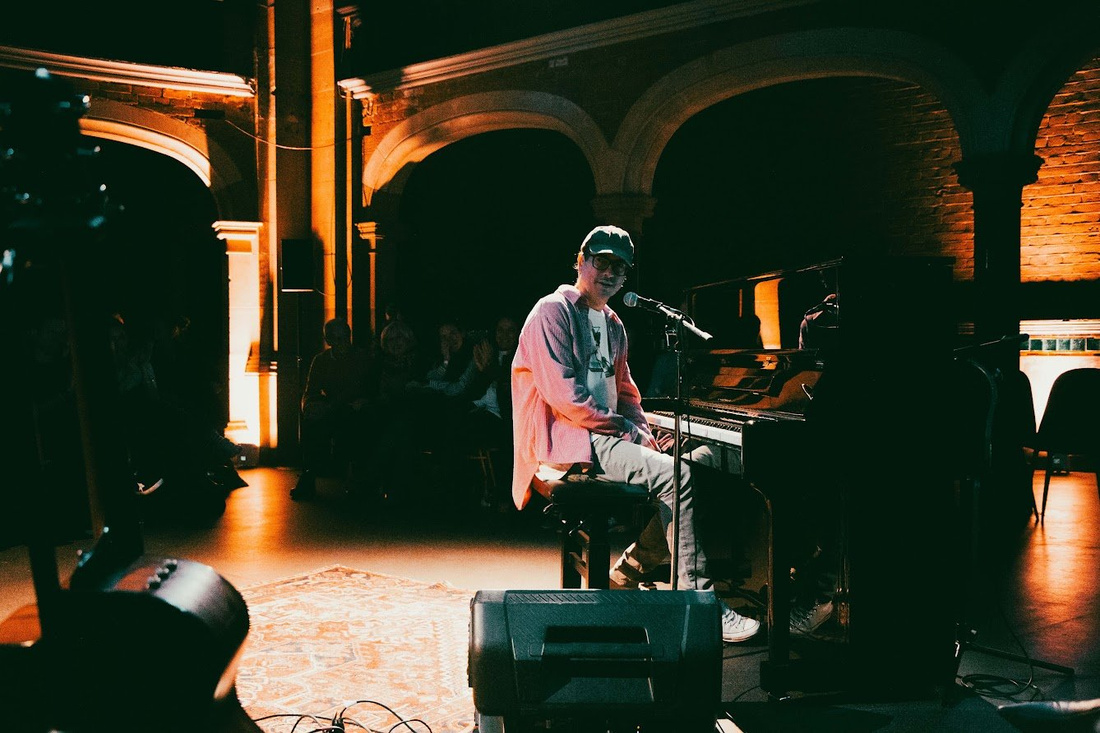
It is a blustery autumn evening in London when Turkish singer Harun Tekin performs songs from his debut solo EP, A Dictionary of Night, at Stone Nest.
The cozy setting in the converted church is a welcome relief from the drizzle outside, and Tekin greets the audience from a stage that feels like his living room. A piano sits at one end of a red, threadbare rug, with a solitary guitar at the other.
It is a considerable change of setting for a musician accustomed to performing to thousands. As the lead vocalist of the Turkish rock band Mor ve Ötesi, Tekin represented Türkiye at the Eurovision Song Contest in 2008 and has performed to over 35,000 people at Istanbul's İnönü Stadium. But tonight, the audience is seated just feet away from where Tekin plays.
The six-track EP explores the idea of "Night" through a collection of carefully chosen reinterpretations. Inspired by both British and Turkish influences, Tekin revisits work ranging from The Beatles to Elton John, alongside celebrated Turkish artists including Sezen Aksu and Münir Nurettin Selçuk.
Tekin opens with a cover of Münir Nurettin Selçuk’s "Kalamış", delivering a slow but mesmerizing performance. His voice easily carries across the high ceilings of Stone Nest, demonstrating the vocal range that has made him one of Türkiye’s best-known rock singers.
The singer alternates between the piano and guitar, giving each cover its own spin. Tekin's cover of "Golden Slumbers" by The Beatles, originally written by Paul McCartney, is well suited to the piano, with Tekin approaching the familiar number with painstaking care.
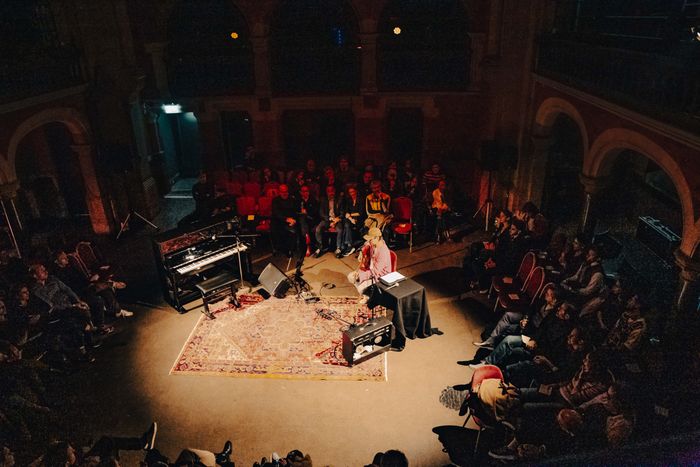
Despite his experience playing in sold-out arenas, Tekin's strength tonight lies in his connection with a more intimate audience.
Every guest is given a small printed dictionary compiled by Tekin himself, which outlines his personal reflections on words associated with the songs. Entries range from 'Music' and ‘Space’, to the Turkish word for healing, 'Şifa', which offers a little more insight into the ideas behind the EP.
Between songs, the Turkish singer is relaxed, swapping jokes with friends and fellow bandmates of Mor ve Ötesi, who are also in attendance. Tekin quips that he should be “playing more and talking less” and explains that he struggles to memorize lyrics by heart, keeping the sheet music in front of him for his cover of "Alaturka" by Sezen Aksu.
Tekun’s willingness to embrace imperfection becomes even more apparent during a subsequent Q&A with State51 founder Paul Sanders. He explains that the small sounds captured during recording, such as the movement of the piano pedal, were deliberately left in. For Tekin, these details are central to his performance rather than flaws to be corrected.
A Dictionary of Night might well be influenced by the work of other artists, but Tekin makes each interpretation unmistakably his own.
We had the opportunity to speak with Harun Tekin ahead of the showcase.
HERE'S THE FULL INTERVIEW:
So, to start things off, could you tell me a little bit more about why you chose the theme “Night” for your EP and what sort of direction you were heading with that?
Harun Tekin: Actually, the theme kind of chose me, because I was working on some tunes, and I realized that many of them had something to do with night, the concept of night. The first thing I was trying to bind them with was the idea of translation, because there are two worlds, like cultural and linguistic roles, that I can connect: the English one and the Turkish one. And when I do anything about one, the other one also keeps talking to me in my mind. So I think I could be translating things. But then I realized there's a more direct concept that I could use. Because most of the songs I'm trying to work on were actually about night. A lullaby or something like that; even in Kate Bush's song, there are people trying not to be drawn. But it's all about night. And then I realized it could be about songs about night as well. So, for the dictionary bits, I also wanted to think about and share, and start a conversation about, the songs as a core set, because I like them so much. So, it is a dictionary of night because I also wanted to write about concepts, songs, and places related to songs.
You say dictionaries, so are you implying that different songs have different definitions of night by that?
Harun Tekin: Everything actually has so many different definitions; the songs define night in their own right, but also every listener defines every word, every syllable in their own world. So, I try to make a really subjective dictionary where I just write my own meanings for things.
Is there a particular song that defines night the most for you, that stands out personally?
Harun Tekin: Yes, I mean, if you ask, from the six on this album, I'm not sure - it may change every day. But this is special for me because I usually I have a band and we usually play only our songs that we write, I write. And so this is something consistent, full of cover versions of other songs that make me think otherwise. I try to understand them. I still try to understand them, and I will keep trying for a while because every time I sing, I understand them better.
So would you say there's a really big difference in performing covers and understanding covers to your own music?
Harun Tekin: Yes, but also, if you sing your own songs, it also takes time to understand them. And sometimes even people understand them better than you.
You bring up a few cultural and linguistic differences between Turkish and English. Is there a particular language that you think you find it easy to understand, or is easier to express emotions and concepts in?
Harun Tekin: It's a tricky question, because it's easier to express emotions in Turkish because of my command of the language, maybe. But it's easier in English because you become less shy, since you are not as good. And that's the way when you start writing songs as well. You try to hide; you try to make it look like it's not you that's writing, it's not you that's singing. And when it's a language other than English, you write in it; then English is a place to hide for many writers from all over the world.
So do you feel like you have a different persona when you perform in English, would you say?
Harun Tekin: No, not like that, but I think now I can relate to other ways of thinking about the songs. Now I can do it better than, let's say, when I was 16 years old. So it's a good time to sing in English!
Yes, that brings us to when you represented Türkiye at Eurovision in 2008 to an international audience. And do you think the way international audiences engage with Turkish music has changed since then?
Harun Tekin: It's a big question. I think there are more and more artists and bands connecting with audiences across Europe, including Türkiye, I mean. There are lots of different and brilliant artists. It's now as easy to release a record, but it's harder to become like a long-lasting artist, so I think that's different now. Maybe in the 90s or 2000s, it was not as easy to publish something. But maybe easier to become something because there was less competition, less technology, et cetera.
So what would you say success is to you then? Is it reaching a broader audience, or is it achieving long-lasting fame?
Harun Tekin: The biggest success is to understand more, I guess. Right now, it is becoming like that.
So is that what you want someone to take - listening to your covers and your songs to really understand sort of this theme of night?
Harun Tekin: If it opens up a new conversation in their lives, that could be seen as a way of talking to them, in a way. So, I think thinking and feeling about these songs, if people do that as well as I do, it would be great.
Nicole: Thank you so much for taking the time to talk to us. That’s a lot of food for thought.
Harun Tekin: No, thank you.
LISTEN TO A DICTIONARY OF LIGHT HERE:
REVIEW BY

Nicole
I love writing about music venues where artists first started out and the rich histories behind them. London is full of iconic spots that musicians performed at earlier in their careers, which have inspired cover bands and lots of new artists hoping to follow in their footsteps.