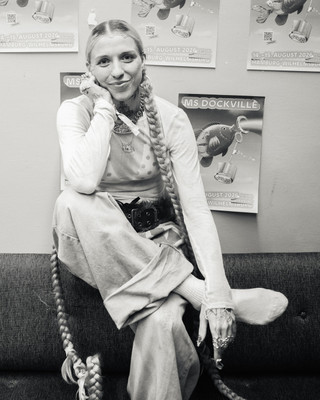
Coasting Into the Night: Alice Merton Returns to Kieler Woche


Each June, Kieler Woche transforms the northern German harbor city into a vibrant hub for sailing, music, and summer crowds from around the world. This year, taking place from June 20 to 28, the Rathausbühne welcomed Alice Merton, the Frankfurt-born, London-based artist whose international breakthrough came with her 2016 hit “No Roots.” Inspired by a childhood spent moving between countries, Merton’s music has frequently explored questions of identity, change, and belonging.
Having previously performed at Kieler Woche in 2022, Merton returned with Visions, her newly released third album. Released through Paper Plane Records, the independent label she co-founded, the record explored self-belief, creative independence, and the courage required to trust one’s own artistic direction.
At a quarter past ten, Merton stepped onto the Rathausbühne to an enthusiastic welcome from a packed, multigenerational crowd, setting out to bring the warm June evening to a euphoric close. Opening with “Coasting,” she immediately established the balance between introspection and infectious energy that would shape the rest of the night.
The title track, “Visions,” provided an early introduction to the central idea behind her new album: the sometimes lonely experience of believing in a creative vision that nobody else can yet see. Before beginning the song, Merton greeted Kiel in an endearing mix of German and English, recalling her previous performance in the city and expressing how happy she was to be back. The crowd responded with delighted smiles and cheers, embracing not only the music but also the warmth and openness with which she presented it.
“Mirage” and “run away girl” continued the energetic opening section before “Boogie Man” brought a darker, more playful edge to the set. Between songs, Merton continued switching naturally between German and English, occasionally searching for the right word and laughing along with the audience when she could not immediately find it.
Following “Learn to Live,” the intensity increased with “Vertigo,” Merton’s exploration of anxiety and the frightening sensation of losing control over one’s own mind. Its restless production translated powerfully onto the stage and prompted one of the loudest reactions of the first half of the show.

Yet some of the evening’s most memorable moments emerged when Merton briefly slowed the pace and explained the experiences behind her songs. Before “Treasure Island,” she reflected on the meaning of home and the pace of modern life, comparing herself to a person aboard a ship constantly buffeted by the waves. The song, she explained, imagined a place to which she could escape when that movement became overwhelming. In a harbor city shaped by the sea, the image felt particularly fitting.
The sense of intimacy continued with “Willow Trees in Tokyo,” which Merton dedicated to her best friend. Before beginning, she divided the Rathausplatz into two halves: one side was instructed to sing “Rain down, rain down, rain down on me,” while the other supplied a long, humming harmony. As the two parts came together, the audience ceased to feel like a collection of individual spectators and instead became part of the arrangement itself.
Merton found another connection to the past in “Landline.” She joked that hardly anyone appeared to use a landline anymore before revealing that she still owned a blue one herself. Her reflections on the nostalgia of calling someone at home introduced one of the evening’s quieter moments, capturing a form of communication that once required patience, uncertainty, and the possibility that somebody other than the intended person might answer.
Any stillness was temporary. For “how well do you know your feelings?”, Merton introduced an uncomplicated, country-inspired dance routine that the crowd could follow almost immediately. Within moments, the Rathausplatz was swaying from side to side, with children, teenagers, and older audience members joining the same deliberately simple choreography. The participation felt effortless rather than forced, reflecting Merton’s ability to make a large festival audience feel included without demanding too much from it.
After “don’t leave me alone with my thoughts” and “Charlie Brown,” she moved to the piano for “Jane Street.” Before playing, Merton spoke about her father’s sometimes critical perspective and about the conventional expectations attached to a successful career. For her, she explained, reaching the greatest possible level of commercial success had never been the sole purpose of making music. What mattered more was enjoying the performance, sharing it with her band, and creating an experience with the people who continued to attend her concerts. Seated alone at the piano, she allowed that conviction to carry the song without the need for elaborate staging.

“I Don’t Hold a Grudge” led into “Waste My Life,” during which Merton once again drew the audience directly into the performance. Thanking them for choosing to “waste” their evening with her and the band, she explained that the song was really about wanting to spend time with the people one loves. Although she laughingly acknowledged that the sentiment might sound cheesy, she dedicated it to the fans who traveled to her concerts and chose to spend time with her. The resulting singalong made the affection feel mutual.
Then came the song that much of the audience had inevitably been waiting for. Merton began “No Roots” at the piano, briefly presenting her best-known hit with unexpected restraint before the performance transformed within seconds. Leaving the piano behind, she took command of the stage as the song’s familiar rhythm swept across the Rathausplatz. From the first recognizable lines, hundreds of voices joined hers, turning the song inspired by never fully belonging to one place into the evening’s largest collective moment.
Importantly, “No Roots” did not overshadow the newer material that had preceded it. Instead, it revealed the thread running through Merton’s work: the search for home, the instability of movement, and the determination to define a life on one’s own terms. Almost a decade after the song first introduced her to an international audience, those questions remained present, but Visions approached them with the confidence of an artist increasingly willing to trust her own answers.
“Why So Serious” initially appeared to bring the night to its conclusion. Before beginning the song, Merton thanked the audience and reflected on how much she had enjoyed bringing Visions to the stage. She and her band then walked off together, but the crowd showed little intention of allowing the evening to end. Persistent cheers and calls for one more song drew the musicians back onto the stage just moments later.
With “The Other Side,” Merton rewarded that persistence and offered the Rathausplatz one final performance. By the time she left the stage for good, she had presented more than a collection of new songs and familiar hits. Through personal stories, bilingual humor and repeated moments of audience participation, she had transformed a packed festival square into something far more intimate.
Visions centered on the courage to follow a direction that others might not yet understand. At Kieler Woche, Merton appeared entirely at home following her own.
Setlist
Coasting
Visions
Mirage
run away girl
Boogie Man
Learn to Live
Vertigo
Treasure Island
Willow Trees in Tokyo
Landline
How well do you know your feelings?
Don’t leave me alone with my thoughts
Charlie Brown
Jane Street
I Don’t Hold a Grudge
Waste My Life
No Roots
Why So Serious
The Other Side
CHECK OUT ALICE MERTON HERE:
WRITTEN BY

Michelle
I write about the stories and emotions that shape music, culture and conversations. While exploring the impact of media and pop culture, I like to put a particular focus on the voices of women and their evolving place in the industry. I am especially drawn to interviews that go beyond the surface, uncovering the perspectives and personalities behind the work.