Finding My Way Back to Pink

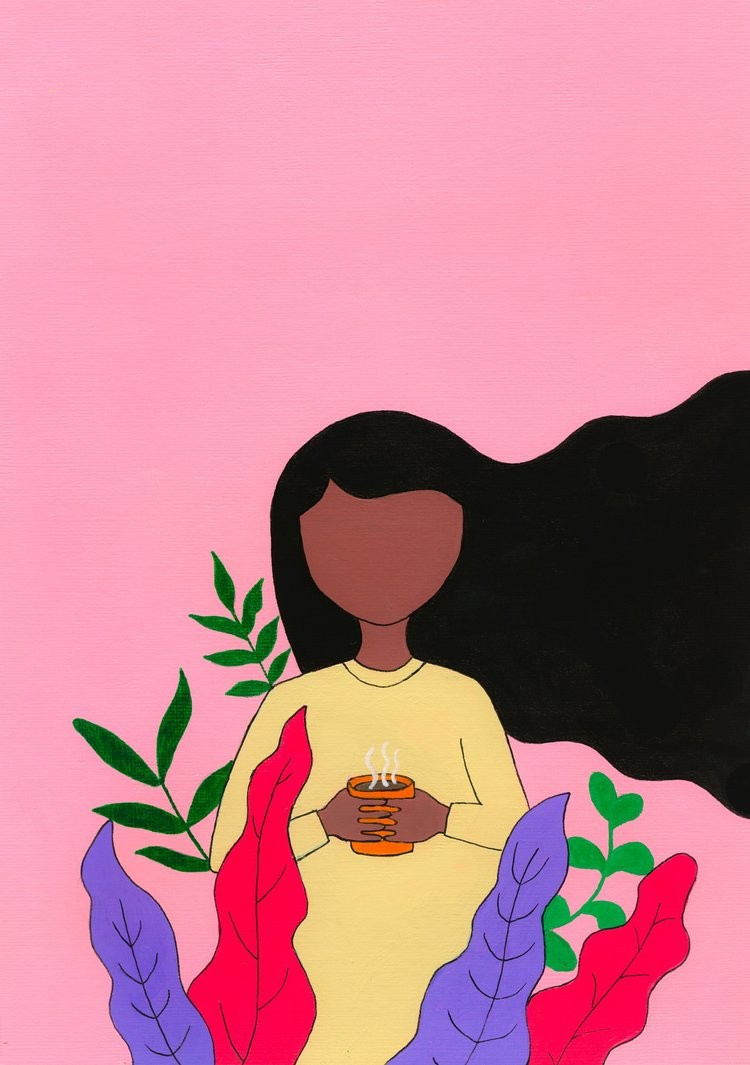
Art by Henna Bakhshi (@browngirlart)
My first act of rebellion at eight years old wasn't dramatic. It was the moment I rejected Barbie dolls, not because I particularly disliked them, but because I revelled in the surprise on the face of whoever wasn't expecting me to reach for a Power Rangers toy instead.
Looking back, I think what I was really doing was resisting a script I hadn't agreed to. The colour pink, the dolls, the glitter – they weren't just preferences being suggested to me, they were a personality that was assigned to me. And there's something instinctive, almost self-preserving, about a child pushing back against that. You don't want the toy. You want to be seen as your own person first.
This connection of my rebellion to the colour 'pink' stood out to me because of the recent social media trend of women embracing the colour pink again – and why it feels so healing to so many of them. It made sense that for a lot of us, rejecting pink wasn't really about the colour. It was about rejecting the reduction to a stereotype. The "you're a girl, so your favourite colour must be pink"-stereotype that stripped away individuality and made femininity feel like a cage rather than a choice. Reclaiming it now, on our own terms, feels healing precisely because it closes that loop – we're no longer running from something. We are rejecting convention by not actively non-conforming to it. We are ignoring its existence. Because we just don’t care for it (or against it) anymore.
Back then, I found different non-conforming choices that empowered me — playing with toys designed for 'boys', choosing pants over skirts, rejecting anything glitter-related on principle. And I know a lot of us found our own versions of this. But now, I also recognise that a lot of us fell into a similar "pick me" trap along the way. And honestly, it makes complete sense why. When society doesn't leave room for individuality within femininity, when being girly is painted as shallow being "one of the girls" means being stereotyped, you end up with young women quietly distancing themselves from each other just to feel like a full person. We never actually disliked each other. We just hadn't found solidarity yet. We hadn't found the peace in both our shared and our different traits.
It's also, I think, a deeply flawed design that society seems to embed from the moment girls are old enough to be compared to each other. Always putting women in competition against each another, making femininity itself something to be either performed or escaped, but never simply lived. That's why it's so beautiful that many of us also broke out of that head-space eventually. I remember listening to “Most Girls” by Hailee Steinfeld as a teenager and having quite a revelation in 2017 because something in that song named what I hadn't been able to articulate: that being like “most girls” was never the problem. The problem was that nobody let most girls just be.
It's interesting to see what changed collectively, for so many people, around the same time. That people started to embrace the very things they once had to reject in order to rebel against societal norms, and felt genuinely healed by that embrace. In my opinion, healing came not just from reclaiming the thing itself, but from finally feeling secure enough in their identity that a colour, a toy or a preference no longer had the power to define or diminish you. That security takes time. It takes feeling empowered in other areas of your life first. Which is why this reclamation isn't really possible during your developing years when you're still in the thick of figuring out who you are, non-conformity is often the only tool available to protect your sense of self.
And now that all is said and done ...
There are two reasons I'm still choosing to write about this today.
The first is to celebrate this reclaiming of non-conformity by giving no space in your life to existing conventions to even care about whether you are conforming to them or not. That is an ultimate win – and I hope everyone's societal environment is kind enough to let their achievements shine.
My second reason is the inspiration I’ve drawn from some of the wonderful women I've had the privilege of calling friends and having real conversations with.
Something I think that often goes unexamined is that non-conformity itself can be manipulated. Conventions aren't always neutral defaults that some people follow and others don't. Some are deliberately designed so that the reaction to them works against us. If a convention is constructed in a way that makes us prove something, avoid something or sacrifice something in the name of rebellion — then the rebellion itself has been engineered. Our non-conformity becomes just as controlled as our conformity would have been. The "nagging wife" trope that gaslights women into not expressing their emotional needs or the "gold-digger" narrative that holds women back from having financial expectations from a partner – are just a few examples.
Certain narratives are constructed specifically against women — not as neutral social observations, but as traps with a very clear beneficiary. The mechanism is always similar: paint women in a particularly unflattering light, give them something to prove, and watch as the fear of that perception shapes their choices in ways that quietly benefit men.
In the end, I want to acknowledge that there is no one rule for all. In different situations, through different lenses and lived experiences, things operate differently. That's the beauty of rejecting the idea of a universal social convention. Your truth looks different from someone else's.
So, if you participate in active non-conformity, I hope you find it incredibly empowering — as I do, on the many occasions I practise it myself. There is just one angle I noticed in my own non-conformities that I felt was worth naming: Sometimes, a form of non-conformity can be manipulated by societal forces to be detrimental to yourself, which is what prompted me to explore this angle at all.
Our well-being and happiness matters more than proving someone wrong. Choosing yourself is the most empowering act of all.
Written by
Ravgun Kaur
I believe in the simple brilliance of philosophical rambling, and how a single thought can lead to completely unexpected territory. I tend to start writing about one thing and end up sharing deeper thoughts on something else entirely — unexpected, and hopefully worthwhile. I want to delve deeper into everyday things — literature, music, life in general — and share whatever I find along the way. Sometimes you'll find me writing experimental poetry, or short stories, too.