A Dollhouse in the Moors – The Domestication of Heathcliff and Cathy in the New 'Wuthering Heights' Movie

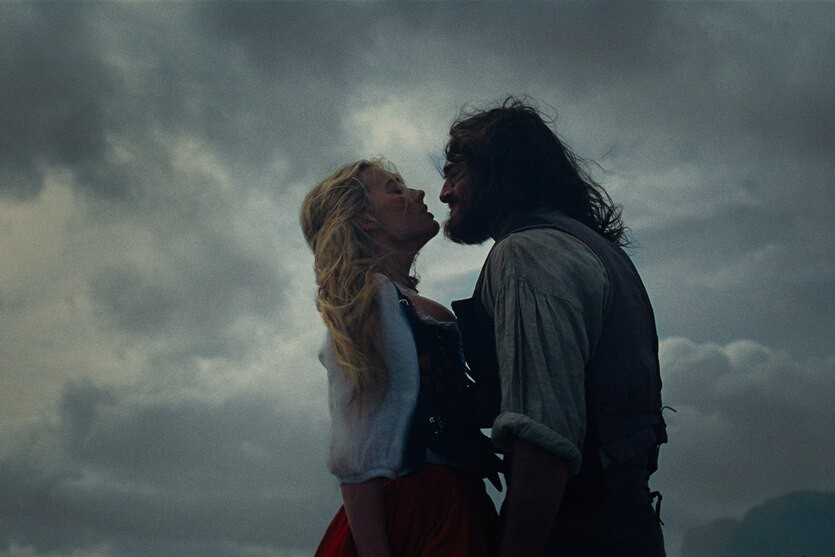
“He’s more myself than I am. Whatever our souls are made of, his and mine are the same.” A sentence that is burned into the minds of literary history and that is undoubtedly interwoven with the names of Cathy and Heathcliff from the 1847 novel Wuthering Heights by Emily Brontë. In its complexity, its exploration of moral ambivalence and disorder, and its scandalous exposure of human nature, Emily Brontë created one of the most unique classics of British history – so unique that it has always proven a challenge to bring the novel to the big screen and capture its essence. Because, quite frankly, it is more than challenging to even agree upon what the very essence of it is. Wuthering Heights reads like a Rubik’s Cube; once you think you solved it, another layer or challenge appears and it is impossible to grapple with the layers of the novel. Is it a love story? Sure. Is it a comment about class and race in 19th-century England? Sure. Is it a gothic story about a haunting? Sure. Is it a revenge story? Also, sure. But what it ultimately conveys, independent of its motifs, is moral ambiguity, emotional release, obsession, and emotional and structural violence. Consequently, movies have chosen a certain perspective and motif to represent, and rightfully so, as a different medium necessarily needs a different approach. However, the greatest achievement lies in transmitting the essence of the story to the big screen. Whether Wuthering Heights is even a novel that can be translated into a movie of the same complexity is a matter of subjective interpretation.
Now, Director Emerald Fennell brought the classic to the big screen. She has undoubtedly sparked debate in recent years, with controversial movies like Promising Young Woman and the even more controversial Saltburn, which starred Jacob Elordi, Barry Keoghan, and Rosamund Pike and received critical acclaim. Although Fennell directed only two movies before Wuthering Heights, she has developed a unique style marked by provocation, scandal, and a playful engagement with disgust. Ultimately, Fennell has mastered pairing ambiguity with provocation while also creating unique sets that speak their own language in a Wes Anderson-like manner. Her undeniable talent seemed a good fit for a provocative novel like Wuthering Heights, as her ability to cross lines matches its ambiguous nature and could bring it to a 21st-century audience. From the very beginning, the noise around the movie was loud: the controversial casting of Margot Robbie as Cathy and Jacob Elordi as Heathcliff as well as the debate over the costumes' inaccuracy for 19th-century England. Eventually, everything came together in the movie's promotion, which portrayed Robbie and Elordi as obsessed with one another – with Robbie driving the narrative by presenting Elordi as a heartthrob everyone should go crazy about, while Elordi remained the mysterious, silent man on her side. Definitely a decision to try and carry the characteristics of Cathy and Heathcliff from the movie into its promotion. Of course, the internet ate it up and anticipation was already fueled by controversy before the movie even premiered.
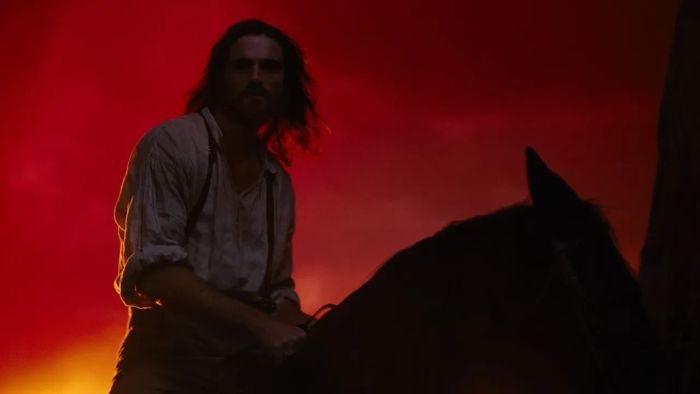
Eventually, it became hard to ignore the noise around the movie and the movie bursted like a bubble, even in its own regard. What the movie ultimately does is domesticate and romanticize the story’s moral disorder, creating a modern melodrama in the tradition of Gone with the Wind.
Cathy and Heathcliff are domesticated in the sense that the complexity of two morally flawed people is reduced to romantic suffering. In this adaptation, Heathcliff and Cathy are the centerpieces, with the movie focusing not on their complexity as characters and a couple but on their passion for one another. However, both characters are reduced to traits, resulting in their passion overshadowing their emotional complexity. Cathy is reduced to a single, legible flaw, her social vanity, which evacuates her emotional volatility. She is forced into a marriage with a rich man since her abusive father has ruined the family financially. Consequently, Cathy has no guiding principles of her own and becomes a victim of the circumstances that make her a prisoner in her marriage.
Heathcliff is stripped of words, and if he communicates, it is to assure Cathy of his love. Occasionally, he is shown to be choleric. However, this trait, which could lead to the moral bankruptcy of his character, later turns into calculated actions. Consequently, both become caricatures of their character, driven by physical passion and lust. Eventually, the two main characters develop a psychological shallowness that erodes their moral ambivalence. This shallowness is underlined by the choice of narration: Their blooming love and passion for one another in the middle of the movie is presented through a montage resembling a music video. Sadly, this also carried over to the side characters. In a story in which ultimately only six characters are relevant to the plot, four of them become plot devices to keep Cathy and Heathcliff apart. They both bond over their experience of domestic abuse, fall in love, and are separated by miscommunication and the malicious intent of a jealous maid. When Cathy and Heathcliff eventually reunite, Cathy is bound to a dull, rich husband, which drives them both into starting an affair. The movie fails to give Cathy and Heathcliff any scope of autonomous action.
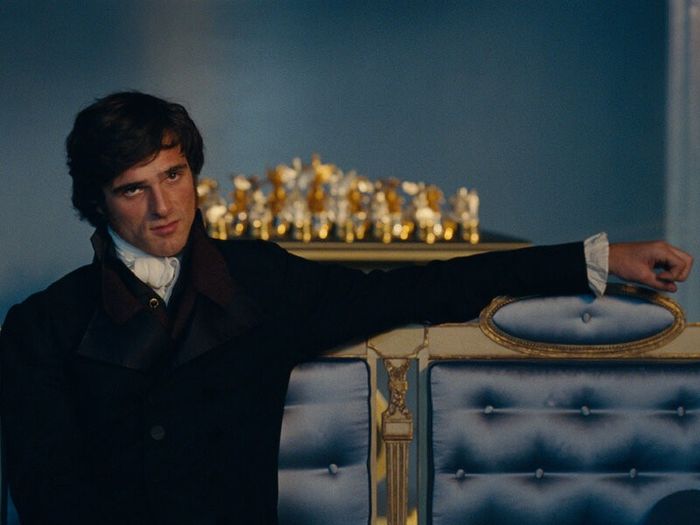
Of the actors, Jacob Elordi certainly manages to create a Heathcliff that stays in the viewer's mind, as he manages to transmit the frustration and anger of him well. A notable scene is one of the quieter ones in which Elordi gives a grimness to Heathcliff that is certainly worth noticing.
The characters are placed in a screenplay that lacks dramatic tension; Instead, it is a floating narrative of ongoing miscommunication that never reaches its climax. The characters are not driven into irreversible decisions that challenge them. Throughout the movie, Cathy and Heathcliff remain confined to a life of secrecy, first as teenagers and later as adults. This is certainly driven by two key issues: First, the movie fails to convey the moral ambiguity of its characters. Certainly, not every movie needs to build up to a climax. However, this decision consequently demands psychological examination. Wuthering Heights challenges moral compasses and forces the reader to sympathize with characters who are driven beyond any possibility of redemption. While being utterly appalled by characters’ behaviors that drive each other into emotional and physical abuse, they sometimes show the most honest and human emotions of love.
It is certainly a challenge to convey the scandalous nature of a 1847 novel to modern audiences, who have far more tolerance for certain images than Victorian audiences did. However, Fennell shies away from the story’s actual controversies. Yes, Cathy and Heathcliff endure domestic violence; however, their characters never fully spiral into the emotional bankruptcy that destroys them and everyone around them. Cathy’s biggest flaw is her arrogance but she shows no other signs that could indicate moral ambiguity. Almost the same is true for Heathcliff, who is continuously described as rough and cruel, without committing anything remotely close to emotional abuse and violence until the very last twenty minutes. The question, therefore, remains: Where are these descriptions supposed to lead if no actions follow? Consequently, there is no moral disorder. It is a gesture towards transgression, but no rupture. Secondly, there is the depoliticization of Heathcliff, who is reduced to a mere love interest. With the decision of not making Heathcliff racially ambiguous as in the novel, the structural violence that he endures is left out. Heathcliff is not only driven mad by the loss of Cathy, but also by the fact that he is constantly confronted with his 'otherness'. He begins his life as a servant who eventually rises to the rank of a wealthy gentleman, worthy of Cathy.
However, his ambiguous descent still makes him unaccepted in society and the reality is that he will never be enough. Elordi’s Heathcliff eventually overcomes the obstacle of poverty, the only remaining obstacle to a happy end between him and Cathy being her marriage to another man. It remains a mystery why none of them choose to run off together when structural pressure disappears.
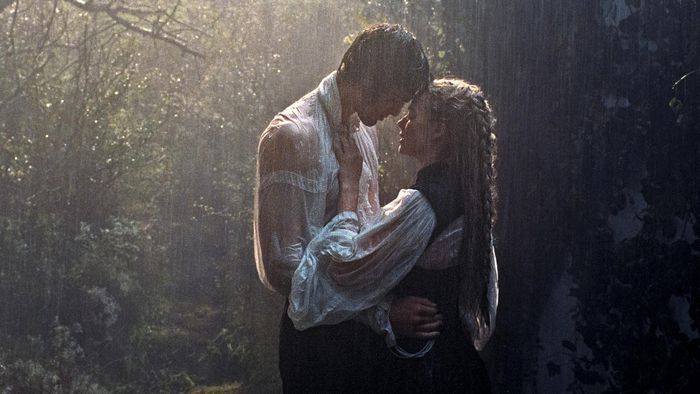
Overall, the impression endures that Fennell shies away from risks. Once more, she chooses to provoke with sexuality, but what is intended as provocation clearly falls short of impact or because it has an aesthetic to it, which is short of any scandalizing aspect. A novel that invites and begs a provocative director to provoke leaves behind exactly this strength to transform Cathy and Heathcliff into a modern retelling of a 20th-century classic romance. Like a classic Hollywood romance, Fennell ends the movie with a montage of Heathcliff and Cathy that traces their love from childhood to adulthood, underscoring once more how tragic it is.
Wuthering Heights is an adaptation of its source material that shies away from challenging its characters and its audience. The beautiful sets and costumes underline the polished, controlled behavior of its characters and lack moral ambiguity. In its aesthetic, Fennell has created a movie that feels like a doll house, which is ironic given the fact that a doll house does play a role in the movie; in which the characters and the story become devices to play out a narrative that is beautifully arranged but plays a relatively safe role.